










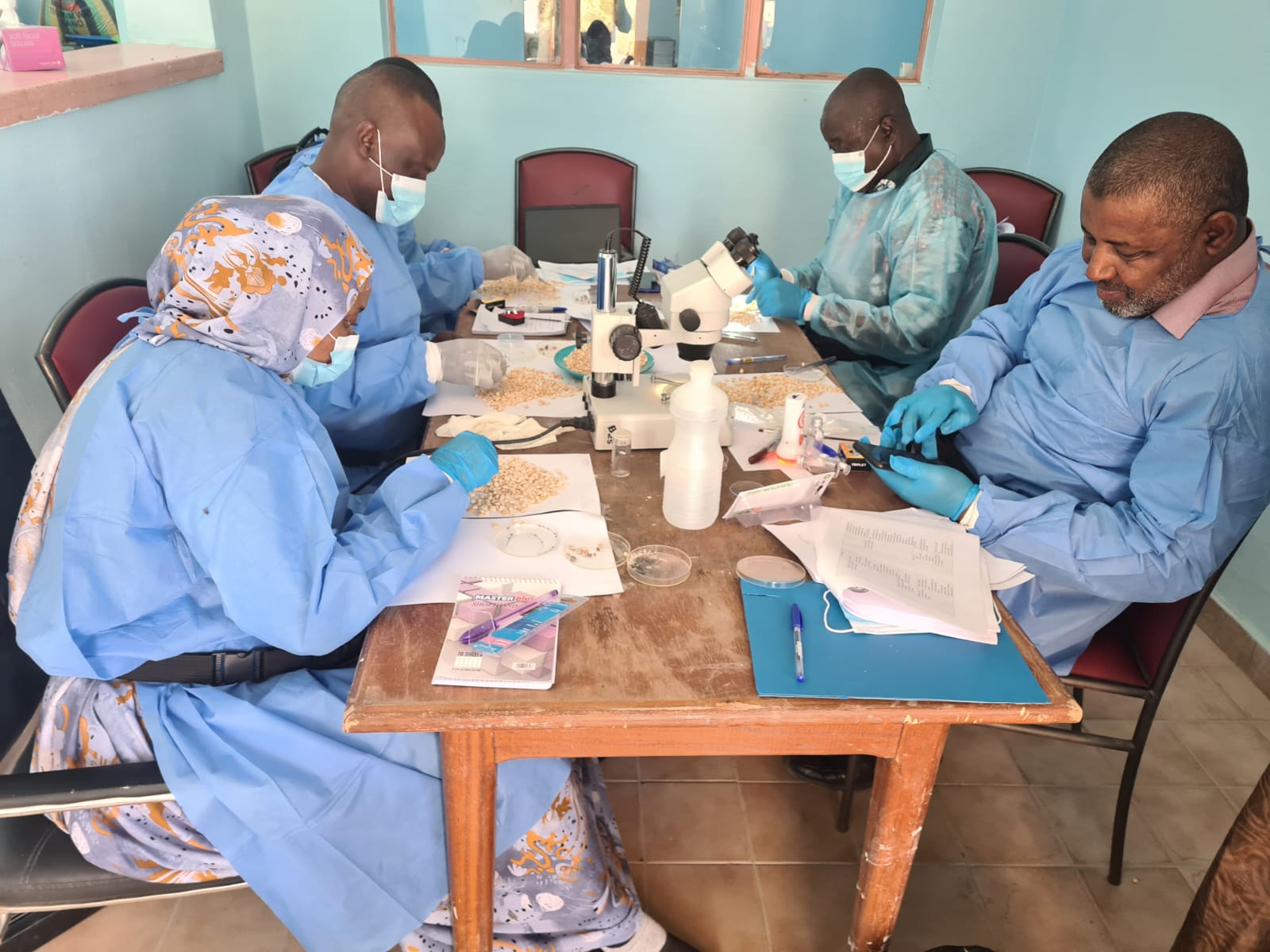
Completion of the Plant Health and Plant Protection training workshop on the use of the Harmonized Phytosanitary Inspection and Decision-Making Guide.
By Admin / 3 years, 5 months agoThe training
workshop for the 15 ECOWAS member States plus Chad and Mauritania on the use of
the Harmonized Phytosanitary Inspection and Decision-Making Guide" in
N’Djamena, Chad for phytosanitary inspectors of Mali, Chad and Mauritania was
concluded.
This is an
effort of USDA-FAS complemented by USAID West Africa Office dedicated to
support West Africa NPPOs Taskforce to disseminate the harmonized Guide in
order to promote best practices in the conduct of plant quarantine operations
in the sub-region. This training was conducted in N’Djamena, Chad from 6-9 February,
2023, briging the total number of trained phytosanitary inspectors to 335 for
the entire region.
The aims and
objectives of the training was :
·
To train in the countries, plant quarantine
inspectors on a better understanding for further use of the Guide
·
Simulation exercises with practical
demonstrations of phytosanitary inspection including pest detection and
identification at the laboratory
·
To test the applicability of the Guide.
Key sessions of
the training are :
1. The presentations
and discussions on the provisions of the Guide related to phytosanitary inspection
procedures for Import & Export
2. The Presentation
of ISPM : 05, 07, 11, 12, 23, 31 & 32
3. Exercises and
practical demonstrations of Inspection, sampling, pest detection and identification
and Decision-making.
4. Field visit one
of the land border between Chad and Cameroon
The measurable
outcomes developing the phytosanitary and decision-making guide as well as the
pilot trainings of national phytosanitary inspectors have achieved these
results:
·
A game changer training
·
1 technical document available, edited and disseminated
·
1 training procedure available
·
15 training sessions conducted at national level in all 17 member States of
the ECOWAS plus Chad plus Mauritania
·
335 inspectors (pilot ToT) trained and capacitated with inspection kit
·
1 regional platform of inspectors established for
real-time exchanges, experience sharing
·
Notification/rejection
at export reduced (mango in particular)
·
Time of transit
reduced (e.g., fluidity mechanism in West Africa & Sahel) to 45 min.
(intra-regional trade)
·
Joint collaboration
and inspection improved at the borders
·
Communication among
phytosanitary inspectors at national level improved
·
National resource
mobilization increased (Cabo Verde, Mali, Guinea conducted step down trainings)